Your Retaining Wall Is Trying to Tell You Something
Are You Listening?
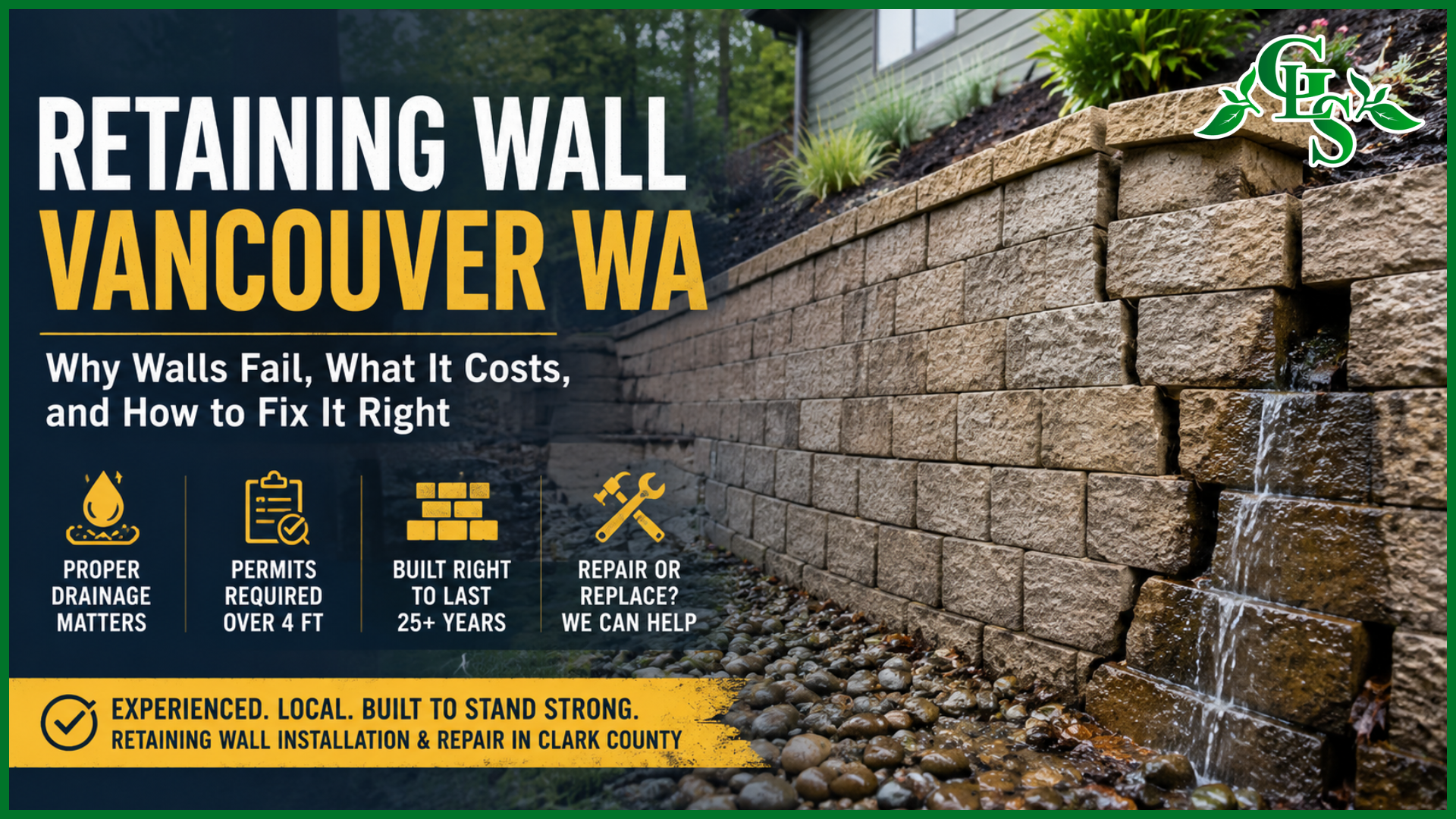
I’ve pulled out a lot of failed retaining walls in Vancouver over 15 years. Railroad ties are rotting at the base. Block walls that shifted two inches over one wet winter. Homeowners who watched a small lean turn into a full collapse because they waited too long.
A retaining wall isn’t decorative. It’s structural. And in the Pacific Northwest, where we get heavy rain for six months straight, a wall that isn’t built right won’t last.
I offer retaining wall installation and repair across Vancouver and Clark County. Here’s what I’ve learned about why walls fail, what they cost, and when to call someone before the problem gets much bigger.
Key Takeaways:
- Most retaining wall failures in Vancouver come from drainage problems, not bad materials
- A wall that’s leaning even slightly needs attention now, not next year
- Clark County requires permits for retaining walls over 4 feet tall
- Proper installation with drainage rock and deadman anchors is what separates a 5-year wall from a 25-year wall
- Replacing a failed DIY wall almost always costs more than hiring right the first time

Written by Juan Garcia
Founder of Garcia’s Landscaping Services
Vancouver’s premier landscaping service.
Table of Contents
- Why Retaining Walls Fail in the Pacific Northwest
- The Most Common Retaining Wall Problems I See in Vancouver
- What Does Retaining Wall Installation Actually Cost in Vancouver WA
- Do You Need a Permit for a Retaining Wall in Clark County
- Retaining Wall Materials: What Works Best in the PNW
- Should You Repair or Replace Your Retaining Wall
- The Bottom Line
- Frequently Asked Questions
Why Retaining Walls Fail in the Pacific Northwest
Most retaining walls don’t fail because of the wall itself. They fail because of what’s behind it.
Water is the enemy. When rain soaks into the soil behind a wall and has nowhere to go, pressure builds up. That pressure is called hydrostatic pressure, and it’s what pushes walls outward, causes cracking, and eventually brings the whole thing down.
Here in Vancouver, we get around 43 inches of rain a year. Our soils hold moisture. Our hillsides shift. A retaining wall without proper drainage behind it is working against the elements every single wet season.
The fix isn’t complicated. Drainage rock, a filter fabric, and a weep hole or drain pipe give water somewhere to go rather than build up pressure. I put these in on every wall I build. It’s not optional.
Did you know… Hydrostatic pressure can exert hundreds of pounds of force per square foot on a retaining wall. A wall just 4 feet tall holding saturated clay soil can face over 1,500 pounds of pressure per linear foot. That’s why drainage isn’t a nice-to-have. It’s what keeps the wall standing.
The Most Common Retaining Wall Problems I See in Vancouver
After doing retaining wall work across Clark County for 15 years, the same problems come up over and over.
Leaning or bulging. This is the most urgent sign. Even a one-inch lean means the wall is under stress it wasn’t designed to handle. Don’t wait on this one.
Cracking. Hairline cracks in mortar are normal over time. Wide cracks or cracks that run diagonally across blocks are signs of movement in the foundation or soil behind the wall.
Water coming through the wall. If you see water seeping through the face of a wall, drainage behind it has failed. That water is doing damage whether you see it or not.
Sinking or settled base. When the bottom of a wall shifts, the whole thing goes with it. This usually means the footing wasn’t set deep enough or the soil wasn’t properly compacted before installation.
Rotting railroad tie walls. I see a lot of these in older Vancouver neighborhoods. Railroad ties can look solid from the front and be completely rotted through at the base where they’re in contact with soil. By the time you notice a lean, the structural integrity is already gone.
| Problem | Urgency | Typical Cause |
|---|---|---|
| Leaning or bulging | High | Drainage failure or soil pressure |
| Wide cracks | High | Foundation movement |
| Water seeping through face | Medium-High | Failed drainage system |
| Settled or sunken base | Medium | Poor footing or soil prep |
| Rotting wood wall | Medium | Age and moisture exposure |
What Does Retaining Wall Installation Actually Cost in Vancouver, WA
Retaining wall costs in Vancouver, WA, vary widely based on height, length, and material. I’ll give you real numbers.
For a basic concrete block wall up to 3 feet tall, you’re typically looking at $35 to $65 per square foot installed. A taller wall, 4 to 6 feet, runs $60 to $100 per square foot because it requires deeper footings, drainage systems, and often engineered deadman anchors to prevent tipping.
A standard 20-foot wall that’s 3 feet tall might run $4,000 to $7,000 installed. The same wall at 5 feet could be $10,000 to $15,000, depending on the site.
Material choice affects price, too. Poured concrete is the strongest but most expensive option. Concrete block is durable and looks great at a mid-range price. Natural stone is beautiful but labor-intensive. Wood is the cheapest upfront and the most expensive long-term because it rots.
I give free estimates on every retaining wall project. Every site is different, and I’d prefer to look at it rather than provide a number that could be off by 40%.
Do You Need a Permit for a Retaining Wall in Clark County?
Yes, in most cases you do. Here’s the straightforward answer on retaining wall permits in Clark County.
Any retaining wall over 4 feet in height, measured from the bottom of the footing to the top of the wall, requires a building permit from Clark County. Some HOAs have their own rules on top of that, so check both.
Skipping the permit is a real risk. If an unpermitted wall fails and damages a neighbor’s property or a public right-of-way, you’re liable. And if you try to sell your home, a building inspector can flag an unpermitted structure and require you to tear it down or bring it up to code.
I handle the permit process as part of the job. It’s not an add-on. It’s part of doing the work right.
Did you know… Clark County requires a geotechnical report from a licensed engineer for retaining walls over 4 feet on slopes greater than 3:1. Most homeowners don’t know this until they’re already mid-project. I’ve seen DIY projects stall for months because this step got skipped.
Retaining Wall Materials: What Works Best in the PNW
Not all retaining wall materials hold up equally in a wet Pacific Northwest climate. Here’s what I’ve seen over 15 years.
Concrete segmental block is what I recommend most often for residential projects. It drains well, handles freeze-thaw cycles, and looks sharp. It’s also what most engineers will spec for permitted walls.
Poured concrete is the strongest option and good for walls that need to handle heavy loads. It’s more expensive, and you lose some of the visual flexibility of the block.
Natural stone is my favorite from an aesthetic standpoint. Done right, a dry-stacked stone wall fits the PNW landscape perfectly. It’s labor-intensive, which means it costs more, but it can last generations.
Railroad ties and pressure-treated wood are the options I’d steer you away from. They’re cheap upfront. But wood rots, especially in Vancouver’s wet winters. I’ve pulled out dozens of railroad-tie walls that looked fine on the surface but were completely failing underneath.
Gabion walls (wire baskets filled with rock) are a good option for certain drainage applications and steep slopes. They’re permeable by design, which is a real advantage in our climate.
Should You Repair or Replace Your Retaining Wall
This is the question I get most often during estimates. Here’s how I think about it.
If a wall is leaning by more than 2 inches, has significant cracking at the base, or shows signs of foundation movement, repair is usually throwing good money after bad. You’ll fix the symptom without addressing the cause, and in two or three seasons, you’ll be back in the same spot.
If the issue is localized, a section that’s settling, a damaged cap block, or a drain that’s clogged, repair makes sense. I can often fix a section without taking down the whole wall.
The honest answer is this: a wall that wasn’t built with proper drainage will keep failing. It doesn’t matter how many times you patch it. Getting the drainage right is the only permanent fix.
I’ll tell you straight at the estimate whether the repair makes sense or whether you’re better off starting over. I won’t sell you a replacement if a repair will do the job.
The Bottom Line
A retaining wall is one of the most structurally important things on your property. It’s holding back soil, managing water, and protecting everything downhill.
Vancouver’s climate is hard on walls that aren’t built right. The rain, the clay soils, and the freeze-thaw cycles in winter will find every weakness in a wall that was built without proper drainage or footings.
If your wall is leaning, cracking, or letting water through, the time to deal with it is now. Walls don’t get better on their own. They get worse, usually faster than you’d expect.
We serve Vancouver and the surrounding 50 miles. Request a free estimate, and I’ll take a look, tell you exactly what’s happening, and give you an honest recommendation on whether to repair or replace.
Frequently Asked Questions
How long does a retaining wall last in Vancouver, WA?
A properly built concrete block or natural stone wall with good drainage should last 25 to 50 years in the Vancouver climate. Railroad-tie and pressure-treated-wood walls typically last 10 to 20 years before rot becomes a structural issue. The single biggest factor in longevity is drainage. A wall without a drainage system behind it will fail much sooner, regardless of the material.
What are the signs my retaining wall needs repair?
Watch for leaning or bulging in any direction, wide cracks running diagonally across blocks, water seeping through the face of the wall, soil washing out from behind the wall, or the base of the wall sinking or settling. Any visible lean is a sign to call someone before the problem gets worse.
Can I build my own retaining wall in Vancouver, WA?
You can build a wall under 4 feet without a permit in most cases, but I’d still caution against DIY on anything structural. Getting the drainage wrong is the most common mistake, and it’s invisible until the wall starts to fail. I’ve spent a lot of time fixing walls that homeowners built themselves. The repairs almost always cost more than professional installation would have.
How much does retaining wall repair cost vs replacement?
Repair costs depend on what’s failing and how much of the wall is involved. Fixing a localized section might run $500 to $2,000. A full replacement of a 20-foot wall could cost $5,000 to $15,000, depending on height and materials. If the drainage behind the wall wasn’t done right the first time, replacement is usually the smarter investment. I give free retaining wall estimates so you know exactly what you’re looking at before committing.
What is the best retaining wall material for the Pacific Northwest?
Concrete segmental block is my top recommendation for most residential projects in the PNW. It handles moisture and freeze-thaw cycles well, drains properly when installed with the right drainage system, and meets the engineering requirements for permitted walls in Clark County. Natural stone is a close second in terms of aesthetics and longevity, but it costs more to install.