Landscape Lighting Vancouver WA
What to Light, Where to Put It, and What It Costs
Most homeowners think about landscape lighting in December when it’s already dark at 4 pm.
August is actually the smarter time to plan it. The days are long right now, which means you can walk your yard in the evening and see exactly where the shadows fall, where the entry feels unsafe, and where a well-placed light would change the way the whole property looks at night.
I’ve done landscape lighting installation across Vancouver and Clark County for 15 years. Here’s what I’ve learned about what works, what doesn’t, and what homeowners wish they’d asked before they started.
Key Takeaways:
- Planning lighting in summer gives you the best view of your actual shadow patterns
- Low-voltage LED systems are now the standard for residential outdoor lighting in the PNW
- Placement matters more than quantity — ten lights in the wrong spots outperform twenty in the right ones
- Landscape lighting adds measurable value to a home in the Clark County market
- Professional installation handles the wiring complexity that trips up most DIY attempts

Written by Juan Garcia
Founder of Garcia’s Landscaping Services
Vancouver’s premier landscaping service.
Table of Contents
- Why Landscape Lighting Is Worth Thinking About Now
- What Landscape Lighting Actually Does for Your Property
- Types of Landscape Lighting and Where Each One Goes
- Landscape Lighting in the Pacific Northwest: What’s Different Here
- Professional Installation vs. DIY Landscape Lighting
- The Bottom Line
- Frequently Asked Questions
Why Landscape Lighting Is Worth Thinking About Now
August evenings in Vancouver give you something the rest of the year doesn’t: warm nights you actually want to be outside for.
If you’re sitting on your patio at dusk and your yard disappears into darkness past 20 feet, that’s the lighting problem you’re living with. Planning now means the system will be in place before the fall rains hit so that you won’t lose those evening hours.
There’s a practical side to the timing, too. Outdoor lighting installation in Clark County goes faster and costs less when the ground isn’t saturated. Running low-voltage wire through dry August soil is a different job than doing it in November mud.
I always tell homeowners: don’t wait until you’re annoyed by the dark to think about the light. Plan it in the light.
What Landscape Lighting Actually Does for Your Property
Landscape lighting serves three real purposes. Most people focus on one and miss the other two.
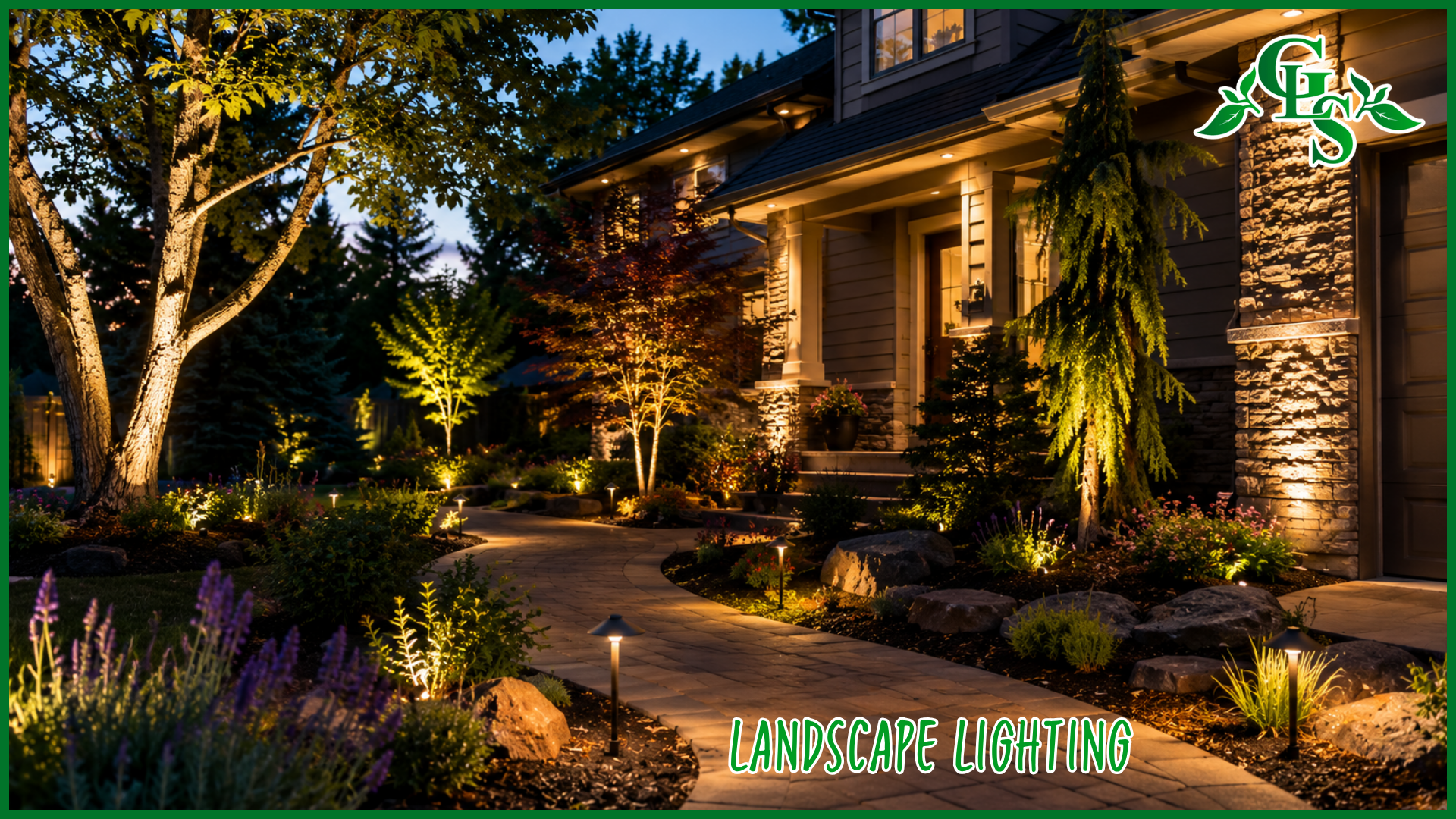
Curb appeal and aesthetics are the obvious ones. A well-lit front yard looks more intentional, more finished, and more valuable. Uplighting a mature tree or washing light across a stone facade changes the character of the whole house at night.
Safety and visibility are the things homeowners undervalue until they need them. A dark front walk, an unlit garage approach, or a backyard with no lighting near steps creates real fall hazards. In the PNW, where we have wet leaves on paths from October through March, good path lighting isn’t decorative. It’s practical.
Security is the third piece. Motion-activated lights near entry points, garage areas, and side gates reduce the attractiveness of a property to someone looking for an easy target. This is a conversation I have often when I’m doing fence services for a homeowner, because fencing and lighting address the same concern from different angles.
A well-designed system does all three at once. That’s what separates a thoughtful installation from just sticking lights in the ground.
Types of Landscape Lighting and Where Each One Goes
Not all landscape lighting is the same. Here’s a plain breakdown of the main types and where I use each one.
Path Lights
Low-profile fixtures mounted on short stakes along walkways and garden borders. These put light at ground level exactly where feet go. They’re the most common type of residential landscape lighting and the most commonly overused. More is not better. Spacing matters. I see yards where path lights are placed every two feet, and the effect is an airport runway, not a garden.
The rule I use is to space them far enough apart that the light pools overlap slightly but don’t merge. You want continuity, not a flood.
Spotlights and Uplights
These do the dramatic work. A spotlight aimed up into a mature tree, across a stone retaining wall, or against the front face of a home creates depth and texture that flat overhead lighting can’t touch.
Uplighting is one of the most effective ways to enhance curb appeal at night. A single well-placed uplight on a featured tree transforms how the house appears from the street.
Placement angle matters a lot. Too steep and you get a harsh shadow. Too shallow, and the fixture washes out. This is where experience makes a difference.
Downlights (Moonlighting)
These fixtures are mounted high in trees or on structures and aimed downward to mimic natural moonlight. The effect is subtle and genuinely beautiful when it’s done right. It works especially well in yards with mature tree canopies.
This is a less common request, but homeowners who have seen it done well specifically ask for it. Once you’ve sat under a well-executed moonlighting setup on a summer evening, you understand why.
Step and Deck Lights
Recessed into the risers of steps or the fascia of a deck, these put light exactly where someone’s foot is going to land. They’re low profile and functional. For anyone who’s had a guest trip on an unlit deck step, this is the fix.
These pair naturally pair with any deck construction or renovation project and are much easier to run during a build than to retrofit afterward.
Motion-Activated Flood Lights
These are the security-focused option. Higher lumen output, triggered by motion, positioned at entry points and dark perimeter areas. They’re not subtle, and they’re not meant to be. The goal is deterrence and visibility, not ambiance.
| Light Type | Best Location | Primary Purpose |
|---|---|---|
| Path lights | Walkways, borders | Safety, aesthetics |
| Spotlights/uplights | Trees, walls, facades | Curb appeal |
| Downlights | Tree canopies | Ambiance |
| Step/deck lights | Steps, deck fascia | Safety |
| Motion flood lights | Entry points, perimeter | Security |
Landscape Lighting in the Pacific Northwest: What’s Different Here
Yard lighting ideas for the Pacific Northwest need to account for conditions that don’t apply in Arizona or Texas.
Rain is the main one. All fixtures need to be rated for wet environments. This is not optional in Vancouver. Fixtures that aren’t rated correctly corrode, fail, and become a maintenance problem within a season or two.
Moss and organic growth matter too. Fixtures set too low to the ground in shaded, moist areas accumulate debris and lose efficiency faster. I position fixtures with PNW conditions in mind, not generic installation diagrams.
Low-voltage LED systems have become the clear standard for residential outdoor lighting in our market. They use a fraction of the power of older halogen systems, last longer, and handle temperature swings without flickering. The upfront cost that Vancouver homeowners pay for a well-designed LED system is quickly offset by lower operating costs.
The other thing I tell customers here is to plan for the dark months. From October through February, your landscape lighting runs more hours per day than anywhere else in the country. A system that’s efficient and durable matters here more than it would in a sunnier climate.
Did you know: A properly designed low-voltage landscape lighting system typically uses less electricity per month than a single incandescent light bulb running continuously. Modern LED landscape lighting is that efficient.
Professional Installation vs. DIY Landscape Lighting
This is worth being honest about, because the answer isn’t simple.
Solar stake lights from a hardware store? Those are fine for low-stakes situations. Temporary, no wiring, low output. They work for what they are.
A proper low-voltage lighting system connected to a transformer and a timer? That’s a different job. The wiring needs to be run correctly, connections need to be weatherproofed, the transformer needs to be sized for the load, and the whole system needs to be balanced so that fixtures at the end of a run receive the same voltage as those near the transformer.
I’ve fixed DIY lighting systems where the homeowner used the wrong wire gauge, daisy-chained too many fixtures on a single run, or buried connections without waterproofing. These fail slowly, which means homeowners often don’t know something is wrong until half the system stops working.
The complexity of the wiring diagram is what trips most people up. You can do a three-fixture accent setup yourself without much risk. A twelve-fixture system covering path lights, uplights, and step lights needs someone who knows how to design the circuit correctly.
Outdoor lighting installation in Clark County is also one of those services where doing it right the first time is significantly cheaper than doing it wrong and then hiring someone to fix it. I offer free estimates so you can see the scope of work before you decide which route to take.
If lighting is part of a larger outdoor project, it’s worth coordinating it all at once. Our stone paver services frequently run alongside lighting work because the path and patio layout determines where the lights should go. Doing them separately means re-working one to fit the other.
The Bottom Line
August evenings are the best time to assess your landscape lighting situation. You’re outside; the nights are long enough, actually, to experience the problem, and planning now means installation happens before the dark months close in.
Think about the three jobs lighting does: curb appeal, safety, and security. A good system handles all three without looking like it’s trying too hard.
If you’re in Vancouver or within 50 miles and want to talk through what a lighting system would look like for your property, reach out for a free estimate. I’ll walk the yard with you and give you a real picture of what’s involved. Call (360) 984-7342 or request a free estimate.
Frequently Asked Questions
How much does landscape lighting cost in Vancouver, WA?
Low-voltage lighting installation in Clark County typically runs $800-$2,500 for a residential system, depending on the number of fixtures, the complexity of the wiring runs, and the transformer size required. Solar stake lights from a retailer cost less upfront but deliver less output, less reliability, and no timer control. I offer free estimates so you know the exact cost before anything starts. No surprises on the invoice.
How long does landscape lighting installation take?
A standard residential install with 8-15 fixtures typically takes one day. Larger systems, properties with mature root systems that complicate wire runs, or jobs that include trenching for main power runs take longer. I give a time estimate alongside the cost estimate so you can plan accordingly.
Will landscape lighting work in the rain and PNW winters?
Yes, with the right fixtures. All exterior landscape lighting should be rated for wet environments. UL-listed wet-rated fixtures handle direct exposure to rain. Damp-rated fixtures are fine for covered areas. I only install fixtures rated for the actual conditions they’ll live in. In 15 years of doing this in Vancouver, I’ve never had a fixture fail from weather when it was installed correctly.
Do I need a permit for landscape lighting in Clark County, WA?
Low-voltage landscape lighting systems, which run at 12 volts, typically don’t require a permit in Clark County. Line voltage work, meaning 120-volt systems run from a standard electrical circuit, is a different matter and requires a licensed electrician. Most residential landscape lighting is low-voltage. I’ll tell you clearly which category your project falls into.
How do I maintain landscape lighting after installation?
LED fixtures require very little maintenance. The main tasks are clearing debris from fixtures in fall, checking connections annually, and replacing any fixture that takes a hit from a lawn mower or foot traffic. I leave every customer with a basic care sheet covering what to check each season. Most systems run for years without needing attention beyond that.
Garcia’s Landscaping Services LLC serves Vancouver, WA and a 50-mile surrounding radius.
Call (360) 984-7342 or request a free estimate at garciaslandscapingsvc.com/contact.